Electronic Grade NaOH: The Cleaning Process Purity Upgrade
2026-11-15

A polishing pad does not look like a strategic semiconductor asset. It resembles an engineered industrial consumable rather than an advanced chipmaking technology. Yet inside a fabrication plant, its behavior can influence surface flatness, defect formation, process stability, and manufacturing yield. That gap between appearance and importance helps explain the competitive strength of established CMP suppliers.

DuPont and Cabot became familiar names in this market through materials expertise and long-standing customer relationships. Their advantage was never simply the ability to manufacture polyurethane. It was the ability to deliver consistent polishing performance within demanding semiconductor processes.
Today, the corporate labels need updating. DuPont’s former electronics business operates as Qnity, while the former Cabot Microelectronics business, subsequently called CMC Materials, belongs to Entegris. The historical names remain useful for understanding the industry, but the current investment exposure sits elsewhere.
DuPont completed the separation of Qnity Electronics on November 1, 2025. The semiconductor materials business associated with DuPont’s CMP heritage now resides within that independent company. Investors should not treat present-day DuPont as interchangeable with its former electronics portfolio.
Cabot in this context means the former Cabot Microelectronics, not Cabot Corporation. Entegris completed its acquisition of CMC Materials in July 2022, bringing its CMP slurries and pads into a broader semiconductor materials platform.
These changes matter because ownership determines the relevant financial statements, capital allocation, and portfolio exposure. A recognizable legacy brand can outlive the corporate structure that originally supported it.
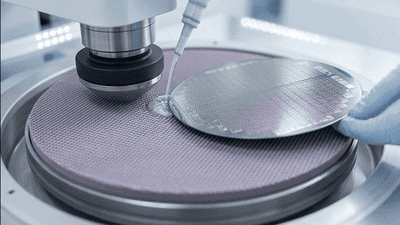
Chemical mechanical planarization combines chemical reactions and mechanical action to flatten wafer surfaces. A slurry works with the pad while the tool controls movement, pressure, and other operating conditions.
The pad helps distribute contact and slurry across the wafer. Its material properties and surface structure influence removal behavior and the consistency of the result.
Hardness, porosity, compressibility, and groove design are therefore functional specifications, not cosmetic choices. Entegris’s pad portfolio explicitly varies these characteristics to address different CMP requirements.
The pad belongs to a coordinated process system. Evaluating it independently of the slurry, conditioner, tool, and wafer application misses much of its commercial importance.
By the time a wafer reaches a particular polishing step, it may already contain substantial accumulated manufacturing value. A problematic consumable can jeopardize that value or create additional processing costs.
This changes the procurement calculation. A lower pad price does not necessarily mean a lower manufacturing cost.
A buyer must consider removal consistency, defect performance, useful pad life, throughput, and maintenance requirements. The relevant comparison is often cost per acceptable wafer rather than cost per pad.
From the factory manager’s perspective, predictable results can matter more than a modest purchasing discount. That creates favorable conditions for trusted suppliers—but does not give them unlimited pricing power.
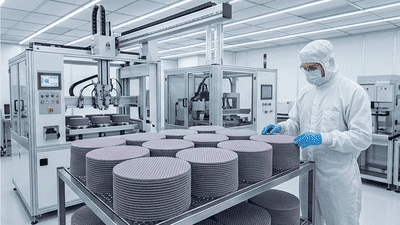
Developing a successful pad formulation is one achievement. Manufacturing it repeatedly with controlled properties is another.
Customers need confidence that incoming lots behave within the qualified process window. Variation in material structure, dimensions, or surface characteristics can complicate manufacturing even when average performance appears satisfactory.
The competitive asset therefore includes production methods, measurement systems, quality controls, and change-management discipline.
An incumbent’s advantage may be difficult to identify from a product brochure because much of it resides in repeatability. The customer is buying the next shipment’s consistency as well as the current shipment’s performance.
A replacement pad must be evaluated under the customer’s actual conditions. Demonstrating an acceptable removal rate is only part of the exercise.
Engineers may need to examine uniformity, defects, surface topography, conditioning behavior, and performance over the pad’s operating life. They must also understand interactions with the existing slurry and recipe.
Testing consumes equipment time and engineering resources. A change that appears attractive commercially can become less compelling once those costs and production risks are included.
The central keyword is qualification. Established suppliers gain durability when their products become part of accepted production processes, not merely when they win an initial purchasing decision.

The title pairs two familiar names, but their competitive histories should not be treated as equivalent.
DuPont’s legacy includes established pad platforms such as IC1000 and Ikonic, now associated with Qnity. Qnity also offers CMP slurries and post-CMP cleaning materials.
The former Cabot business contributed both slurries and pads to Entegris. Its integration expanded Entegris’s offering alongside filtration, cleaning, conditioning, and other process-related capabilities.
Leadership in slurries does not automatically establish leadership in pads. A careful market assessment distinguishes product categories, applications, and qualified positions rather than assigning one broad CMP ranking.
It is tempting to describe the pad market as a simple two-player contest. That framing can exaggerate the evidence.
A market-share claim needs a defined year, geography, revenue or volume basis, and product boundary. Pads should not be combined with slurries and then presented as a pad-only market.
Competitive strength can also differ between advanced logic, memory, mature-node manufacturing, and other polishing applications.
The useful conclusion is narrower: established suppliers can hold strong positions through qualification, process knowledge, and manufacturing consistency. That does not prove that two companies exclusively control every relevant segment.
A capable pad must perform across acceptable operating conditions, not only at one optimized laboratory setting.
Manufacturing encounters changes in incoming wafers, operating time, equipment condition, and process demands. A sufficiently robust process window helps engineers manage those variations.
This is where application support becomes commercially important. Suppliers that can troubleshoot interactions and adjust material characteristics may contribute more value than suppliers offering a nominally similar pad.
The resulting relationship can become collaborative. Customer experience informs product development, while supplier knowledge helps customers reach workable recipes more efficiently.
Pad performance depends partly on how the slurry behaves at the polishing interface. A change in one component can alter the performance of the other.
Suppliers with both capabilities can investigate those interactions together. That can support coordinated development and simplify responsibility when a process needs improvement.
Entegris described shorter development times and a broader suite of CMP solutions as benefits of combining its portfolio with CMC Materials. Qnity likewise markets integrated CMP and post-CMP capabilities.
Integration is an opportunity, not a guarantee. Customers can still combine products from different suppliers when that produces the best qualified result.
Pads wear during use and require replacement. That creates recurring demand linked to manufacturing activity rather than only to new equipment installations.
An installed base of qualified processes can support repeated purchasing, but the revenue stream remains cyclical. Lower utilization, reduced wafer starts, or inventory correction can weaken orders.
Longer pad life can also affect replacement volumes. A technically better product may create customer value while changing the number of pads purchased.
Investors should distinguish recurring consumption from guaranteed growth. The business can be durable and still experience meaningful quarterly volatility.
More demanding structures and materials can increase the importance of controlled planarization. They can also require different balances between removal efficiency, selectivity, flatness, and defect performance.
That creates opportunities for customized pad platforms and higher-value application development.
But “more advanced chips” should not be converted mechanically into a fixed percentage increase in pad revenue. The number of polishing steps, process duration, pad life, and production volume all affect consumption.
Qnity’s newer platforms and Entegris’s advanced-node pad offerings show continuing product development. Their commercial value ultimately depends on qualification and sustained production adoption.
Qualification protects an incumbent in an established process. A new process can create an opening for a challenger.
When customers change materials or architectures, existing recipes may need substantial revision. Engineers may evaluate new pad designs alongside familiar products.
Incumbents benefit from accumulated experience and customer access, but they still need to solve the new application.
The moat is therefore renewable rather than permanent. It strengthens through successful development, reliable supply, and continuing design wins; it weakens if a supplier relies only on its installed history.
Manufacturers have reasons to reduce dependence on a single consumables supplier. Supply resilience, negotiating leverage, and access to alternative technologies all encourage additional qualification.
A second source may not replace the incumbent immediately. It can still influence pricing and provide an option during disruption.
Regional suppliers may also find entry opportunities where customer proximity, support, or supply-chain policy matters.
The incumbent response should be better performance and dependable service, not an assumption that switching costs make customers captive. Qualification creates friction, but customers can invest to overcome it.
A qualified pad that cannot be delivered consistently is not a complete solution. Manufacturing continuity depends on capacity, logistics, raw-material management, and contingency planning.
Customer relationships can therefore reward suppliers that combine process performance with dependable delivery.
Additional facilities and qualified production routes may improve resilience, although transferring production still requires controlled execution.
For the operations team, supply assurance is inseparable from product quality. For investors, it is a reminder that the moat requires ongoing spending and cannot be measured solely through patents or historical market presence.
Qnity and Entegris operate broader portfolios than CMP pads alone. Company-level results reflect multiple product families, customer exposures, and operating priorities.
A compelling pad franchise can therefore be diluted by other financial factors. Conversely, strength elsewhere can obscure weakness within a particular consumables business.
Investors should examine segment disclosure, margins, research spending, capital requirements, cash conversion, and balance-sheet obligations.
Valuation remains essential. A durable business can deliver disappointing returns when its price already assumes unusually strong growth or permanently elevated profitability.
Focus on evidence that links technical performance to commercial durability:
No single metric captures all of these characteristics. Together, they provide a more useful assessment than an unsupported headline market-share figure.
The enduring lesson behind DuPont and Cabot’s CMP heritage is that semiconductor materials can command strategic importance far beyond their physical appearance.
A pad becomes defensible when it delivers consistent results inside a qualified manufacturing process, supported by technical expertise and reliable supply. Today, those historical capabilities should be evaluated within Qnity and Entegris rather than through outdated corporate labels.
The opportunity is attractive precisely because customers value proven performance. The limitation is equally important: each new process, alternative supplier, and investment cycle tests that performance again. In CMP pads, the moat is not ownership of a simple consumable. It is the ability to remain indispensable to an exacting production system.