Sputtering Target Material Transition: Al, Cu, Ti, and Co in Advanced Interconnects
2026-11-01

The semiconductor industry usually describes its vulnerabilities through familiar headlines: lithography restrictions, advanced packaging shortages, scarce photoresists, or interruptions in specialty gases. Yet one of the most consequential dependencies sits much earlier in the manufacturing chain. Before a silicon wafer reaches a fabrication plant, its crystal must be grown. For much of the industry, that means pulling a single crystal from molten silicon held inside a quartz crucible.
This is where an apparently ordinary mineral becomes an extraordinary industrial constraint. Quartz is abundant; quartz suitable for demanding crystal-growth applications is not. The distinction turns a modestly priced upstream material into a potential bottleneck for products worth vastly more downstream. The central issue is not whether the world has enough silica. It is whether manufacturers can obtain enough qualified material, in the right form, with predictable performance inside an unforgiving thermal process.
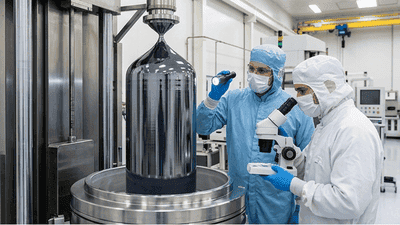
In the Czochralski process, high-purity polycrystalline silicon is melted in a crucible at temperatures above silicon’s melting point, approximately 1,414°C. A seed crystal touches the melt and is gradually withdrawn while process conditions are carefully controlled. Silicon solidifies onto the seed, producing a cylindrical single-crystal ingot that can subsequently be sliced, finished, and polished into wafers.
The quartz crucible is not simply a container. Its silicon-contacting surface participates in the growth environment. Interaction with molten silicon introduces oxygen, while impurities and changes in the crucible’s surface can influence crystal quality. Oxygen is not uniformly undesirable: its effects depend on concentration, distribution, subsequent thermal processing, and the intended wafer application. Successful growth therefore requires controlled interaction, not the unrealistic expectation of a perfectly inert vessel.
For a crystal-growth engineer, crucible quality is inseparable from process stability. For a procurement manager, it is a recurring consumables requirement. For a financial analyst, it is an upstream dependency whose economic importance cannot be measured by its share of total semiconductor spending. All three perspectives describe the same problem, but each reveals a different route through which quartz supply risk can become operational risk.
The word “quartz” can obscure more than it explains. Construction sand, industrial silica, optical materials, and crucible feedstock belong to very different commercial categories. A deposit may contain large quantities of quartz without offering a practical route to the purity and consistency required for demanding crystal growth.
The starting mineral matters because contaminants do not all behave alike. Some occur in separable mineral grains or inclusions. Others are more difficult to remove because of how they are incorporated into the material. Processing can improve purity, but the achievable result, recovery rate, and cost depend on the feedstock. Consequently, a promising resource announcement is not equivalent to immediately available semiconductor-grade supply.
Headline purity also fails to capture the complete specification. Two materials described by the same nominal purity can differ in their impurity profiles, particle characteristics, and behavior during crucible manufacture. What ultimately matters is whether a finished crucible performs consistently throughout the customer’s growth cycle. A laboratory assay is necessary evidence, but it is not a substitute for production validation.
High-purity quartz reaches a crystal puller through several linked stages: mineral extraction, purification, feedstock preparation, crucible fabrication, inspection, and customer qualification. A constraint at any stage can limit usable supply even when another stage appears comfortably provisioned.
This distinction is particularly important when evaluating capacity expansions. Additional mining output may not remove a purification constraint. More purified sand may not resolve a shortage of qualified crucible-manufacturing capacity. Additional crucibles may not help a wafer producer if their performance has not been demonstrated for its specific operating conditions.
The most useful question is therefore not, “How much quartz capacity has been announced?” It is, “How much additional qualified crucible supply can reach the relevant crystal-growth lines?” The second question is harder to answer, but far more meaningful.
This qualification chain also explains why switching suppliers is not a straightforward purchasing exercise. A change in feedstock can affect the finished crucible, which can alter the growth process. The customer must establish that acceptable results persist across repeated runs, not merely that a single trial produces a usable crystal.
Spruce Pine, North Carolina, occupies an important position in the high-purity quartz supply chain. Its significance comes from the suitability of its mineral resources and the processing capabilities developed around them. However, portraying the location as the source of every semiconductor material, or suggesting that any interruption there instantly stops global chip production, oversimplifies the exposure.
A disruption must travel through inventories, processing plants, logistics networks, crucible suppliers, and wafer producers before reaching downstream customers. The timing depends on what material is affected, which grades are available elsewhere, and how much qualified inventory exists at each stage.
The more revealing concern is correlated exposure. Two commercial suppliers may offer separate contracts while relying on the same geographic region, transport infrastructure, or utilities. Buying from both may reduce supplier-specific risk without eliminating regional risk. Supplier diversification and geographic diversification are related, but they are not interchangeable.
For manufacturers, resilience analysis should therefore extend beyond the name on the purchase order. It should identify where the mineral originates, where purification occurs, where crucibles are made, and which shared dependencies could interrupt several nominally independent supply routes.
Quartz crucibles can use differentiated layers rather than a single uniform material throughout their walls. The silicon-contacting region carries particularly demanding requirements because it directly interacts with the melt. Other regions contribute to the crucible’s overall thermal and structural behavior.
This creates a hierarchy within quartz demand. A producer may successfully supply material for one part of a crucible without being qualified for another. Treating all high-purity quartz output as interchangeable can therefore exaggerate available substitution capacity.
Crucible performance also evolves during use. The inner surface dissolves, and bubbles can change under prolonged high-temperature exposure. Material chemistry, manufacturing quality, and operating conditions collectively influence how that evolution affects the growth process.
The practical implication is that purity and lifetime cannot be evaluated independently. An alternative material that looks attractive on purchase price may prove less economical if it narrows the operating window, reduces acceptable campaign duration, or introduces additional variability. Conversely, a more expensive crucible can be economically justified if it delivers sufficiently better usable output.
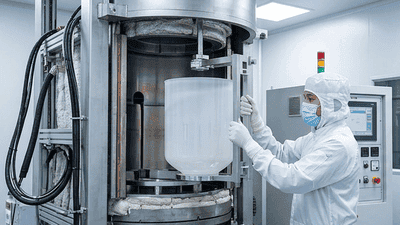
Both semiconductor wafers and monocrystalline photovoltaic wafers connect high-purity quartz to silicon crystal growth. This shared dependence creates a link between electronics and solar manufacturing that is easy to miss when the two markets are analyzed separately.
However, their demand should not be combined without qualification. Semiconductor and photovoltaic producers can have different impurity tolerances, crystal specifications, crucible designs, and operating priorities. Capacity serving one segment is not automatically available to the other.
Rapid photovoltaic expansion can place pressure on overlapping upstream resources and processing capacity. At the same time, a slowdown in solar manufacturing does not necessarily resolve a shortage of the particular grades or crucibles needed by semiconductor customers. Aggregate supply-and-demand figures can conceal tightness within a narrow, high-performance category.
This is also why quartz-demand forecasts should look beyond wafer shipments. Crucible dimensions, silicon throughput, growth duration, recharge practices, and usable output per campaign all influence consumption. Improvements in operating efficiency may moderate material demand, while more demanding process conditions may raise the performance threshold for acceptable supply.
The simplest model of quartz risk assumes a higher material price flows into a higher wafer price. That mechanism matters, but it may not be the most consequential one.
A crystal-growth operation commits silicon feedstock, energy, equipment time, and production capacity before the final usable output is known. If crucible performance contributes to an unsuccessful run or reduces the acceptable portion of an ingot, the economic loss extends well beyond the crucible’s purchase price.
Supply uncertainty can also impose costs without causing an outright shutdown. Manufacturers may carry more inventory, undertake additional trials, adjust production schedules, or reserve capacity around the availability of proven consumables. These responses protect continuity, but they absorb capital and management attention.
For analysts, the relevant transmission channel is therefore broader than raw-material inflation. It includes yield, equipment utilization, qualification expense, inventory requirements, and delivery reliability. A relatively small procurement category can influence several much larger operating metrics.
Synthetic silica offers a route to very high purity without relying on the same natural mineral characteristics. It is therefore an important part of the substitution discussion. Yet “synthetic quartz” should not be treated as a single, universally interchangeable solution.
The manufacturing route, material properties, cost, and compatibility with crucible fabrication all matter. Achieving excellent chemical purity does not by itself establish equivalent performance throughout a complete crystal-growth campaign.
One practical approach is selective substitution: using synthetic material where its purity provides the greatest benefit while retaining suitable natural material elsewhere. That can reduce dependence on particular natural grades without requiring an immediate replacement of the entire crucible supply chain.
Other natural deposits may also contribute to diversification. Their commercial value depends on more than resource size, however. A credible alternative must demonstrate repeatable purification, consistent product quality, scalable economics, and acceptance by downstream manufacturers.
Alternative crystal-growth methods require similar caution. Float-zone growth avoids a quartz crucible in the growth step, but it serves a different set of technical and commercial requirements. It should not be presented as a universal replacement for the Czochralski wafer capacity underpinning mainstream silicon manufacturing.
An effective monitoring framework separates physical availability from manufacturing readiness. Useful indicators include:
Inventory deserves particular scrutiny. A stockpile offers little protection if it consists of unsuitable grades or cannot move through an interrupted processing stage. Likewise, several months of nominal coverage may be misleading if consumption increases or replenishment takes longer than expected.
The strongest contingency plans combine qualified alternatives with appropriate buffers. They also define when to activate those alternatives, who owns the decision, and how production results will be monitored after a change. Resilience becomes more credible when it is embedded in operating procedures rather than left as a procurement aspiration.
High-purity quartz has the characteristics of an attractive industrial niche: demanding specifications, qualification barriers, concentrated capabilities, and customers that value reliable performance. Those characteristics may support durable supplier relationships, but they do not guarantee attractive returns for every participant.
A strong investment case must distinguish resource ownership from processing expertise and customer acceptance. It should also test expansion costs, achievable recovery rates, product mix, contract terms, and the time required to convert announced capacity into revenue.
Scarcity can encourage competing supply, material substitution, and process improvements. A supplier’s advantage is therefore strongest when it rests on repeatable delivered performance, not merely on a claim that its mineral is rare. For downstream wafer producers, the corresponding advantage is the ability to maintain output when competitors face qualification or replenishment constraints.
High-purity quartz supply risk is ultimately a question of how much dependable crystal-growth capacity the material system can support. The vulnerable point is not simply a mine, a sand shipment, or a crucible factory. It is the connection between geological suitability, processing consistency, crucible quality, and an accepted operating window.
That connection gives monocrystalline pulling its strategic significance. Semiconductor supply chains can expand equipment capacity and secure silicon feedstock, yet still encounter limits if the vessel holding the melt cannot deliver predictable results. Understanding that dependency requires looking past mineral abundance and toward the harder measure: reliable, qualified output under real production conditions.