Wet Chemicals G5 Purity: The Domestic Qualification Breakthrough
2026-10-21

A semiconductor’s most important materials are not always visible in the finished device. Some arrive at the factory inside specialized containers, enter a deposition chamber as vapor, and disappear into films only a few nanometers thick. These precursors help form the insulating layers, electrodes, barriers, and other structures that allow modern chips to operate.
As semiconductor manufacturing becomes more three-dimensional, precursor chemistry is moving closer to the center of process development. Korea’s suppliers occupy an influential position because they operate alongside a demanding memory-manufacturing ecosystem. Their advantage combines chemical expertise with customer access, engineering collaboration, and accumulated production experience.
Yet “Korean supplier dominance” needs boundaries. It describes strength in selected products and customer relationships, not a proven monopoly across every ALD and CVD precursor. The defining advantage is often integration: a molecule, delivery system, deposition tool, and manufacturing recipe developed to work together.
A precursor supplies the chemical building blocks for a deposited film. It may contain silicon, hafnium, zirconium, titanium, tungsten, or another element needed in the final structure. Its surrounding chemical groups influence volatility, stability, and reaction behavior.
In chemical vapor deposition, or CVD, vapor-phase reactants undergo reactions that produce a solid film on the substrate. Different CVD processes use heat, plasma, or other activation methods, and their operating characteristics vary widely.
Atomic layer deposition, or ALD, separates reactant exposures into a sequence. Ideally, each exposure produces a self-limiting surface reaction, with purging between steps. Repeating the sequence allows controlled film growth and can provide excellent coverage over complex surfaces.
ALD is not automatically superior for every application. Throughput, temperature limits, film properties, and cost remain important. Manufacturers select deposition methods around the complete process requirement, rather than treating atomic-scale thickness control as the only objective. Precursor selection likewise depends on properties such as volatility, thermal stability, reactivity, and compatibility with the intended deposition conditions.
Planar surfaces are relatively accessible. Deep holes, narrow trenches, and vertically stacked structures are not. A deposition process must deliver reactants into difficult geometries while maintaining acceptable thickness and composition.
This challenge links precursor demand to the evolution of DRAM, 3D NAND, and advanced logic. Increasing structural complexity creates opportunities for chemistries that support conformal coverage, lower-temperature processing, and tighter control of interfaces.
Industry analysis identifies continued 3D NAND scaling and high-k metal-gate adoption as important drivers for deposition materials. It also connects DRAM process changes with additional requirements for ALD and CVD hardmask materials. These are distinct demand channels, rather than one uniform expansion in precursor consumption.
Crucially, complexity does not translate into a fixed multiplier. Adding device layers does not mean every layer requires the same deposition sequence or chemical quantity. The outcome depends on architecture, process integration, chamber operation, and material utilization.
DRAM stores information using capacitors whose performance must remain adequate as device dimensions shrink. Maintaining capacitance while controlling leakage places demanding requirements on dielectric films and their interfaces with electrodes.
High-k materials help address that challenge by providing higher dielectric permittivity than conventional alternatives. Hafnium- and zirconium-containing chemistries are part of the broader high-k precursor landscape, alongside other materials chosen for particular device structures.
The deposition process must control more than thickness. Composition, residual contamination, interface quality, and subsequent thermal behavior all influence the finished device. A precursor that produces an acceptable film on a simple test wafer may still struggle in a production capacitor structure.
For suppliers, this creates an opportunity to participate in development rather than merely deliver chemicals after a recipe is finalized. It also creates exposure to customer technology choices: success depends on which material systems enter production and how extensively they are adopted.
For 3D NAND, vertical scaling changes both the amount of structure on a wafer and the difficulty of reaching its interior surfaces. Deep features can require carefully managed exposures, purges, and reaction conditions.
Some processes may need more precursor delivery to achieve adequate coverage. Others may improve utilization through equipment or recipe changes. Architecture revisions can also redistribute demand among dielectric, conductor, and barrier chemistries.
This makes wafer starts an incomplete demand indicator. A factory producing the same number of wafers can consume a different precursor mix after a technology transition. Conversely, rising device output does not guarantee proportional revenue growth for every chemical supplier.
The useful question is therefore not simply how many NAND layers a customer announces. It is which deposition steps change, which materials are selected, and how those changes affect qualified consumption per wafer.
Korea’s precursor ecosystem developed alongside Samsung Electronics and SK hynix. Proximity to major memory customers gives suppliers opportunities to understand process requirements, respond to problems, and refine products through repeated manufacturing feedback.
DNF illustrates the importance of that relationship. Its collaboration with Samsung on locally developed patterning-related precursors dates back to 2005, while Samsung’s 2021 equity investment supported the supplier’s materials-development efforts. These links show how customer participation can reinforce a domestic chemical capability over time.
Geographic proximity is only part of the explanation. A supplier must convert access into reliable synthesis, purification, analytical control, and application support. Customer familiarity cannot compensate for unstable material quality.
Still, a successful development cycle can become self-reinforcing. Production experience helps the supplier diagnose issues; effective support builds customer confidence; that confidence creates opportunities in subsequent process generations. The resulting advantage is difficult to reproduce through a new production plant alone.
The Korean precursor landscape contains multiple companies with different product portfolios. DNF, Soulbrain, Hansol Chemical, and UP Chemical appear among established suppliers in the broader ALD and CVD materials market. Their inclusion does not establish equal market shares or identical technical capabilities.
Hansol Chemical, for example, identifies silicon precursors among its semiconductor materials, while its broader portfolio includes high-k and electrode or metal precursor products. This breadth should be evaluated by specific application rather than reduced to one company-wide leadership claim.
Global competitors remain important. The market also includes Merck, Air Liquide, ADEKA, Entegris, and other specialist suppliers. Consequently, Korea’s strength is better described as a significant position within an international, chemistry-specific supply network than as control of the entire category.
A company may be highly competitive in one memory application while having limited participation in another. Mapping products to customers and process steps reveals more than comparing lists of corporate names.
Nationality becomes less straightforward when corporate ownership and production locations diverge. UP Chemical is a particularly useful example: it operates from a Korean industrial base but was acquired by China’s Yoke Technology in 2016.
In September 2026, Yoke stated that some precursor business had transferred from UP Chemical to newly commissioned capacity at Jiangsu Sincere. It also explained that this transfer affected UP Chemical’s reported revenue. A change in one subsidiary’s sales therefore need not mean an equivalent decline in the group’s underlying precursor business.
This distinction matters for both investment analysis and localization policy. Manufacturing location, ownership, technical heritage, and customer qualification are separate dimensions. Combining them under a national label can obscure where capabilities actually reside.
International groups can expand through acquisition and manufacturing transfer, while Korean-origin expertise remains embedded in their development programs. The competitive landscape is dynamic, not a fixed contest between isolated national supply chains.
A precursor is qualified within a process, not in isolation. The customer must establish that the material works with its deposition equipment, delivery conditions, co-reactants, and downstream manufacturing steps.
Replacing it can require adjustments to temperature, exposure time, purge duration, or other operating parameters. Even nominally identical chemistry may differ in trace impurities, stability, or delivery behavior.
The customer also needs confidence in repeated batches. A development sample cannot establish that a supplier will maintain acceptable quality through feedstock changes, equipment maintenance, and increased production volumes.
These requirements create switching friction. Once a material is embedded in a stable process, changing suppliers can introduce engineering expense and production risk. However, qualification is not a permanent guarantee: customers can approve alternatives, redesign processes, or adopt different chemistries in later generations.
The strongest supplier position combines an existing production role with a credible pipeline for future requirements. Defending yesterday’s recipe is less valuable if the next architecture uses a different material system.
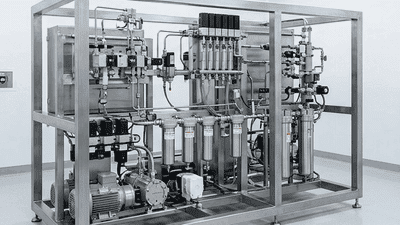
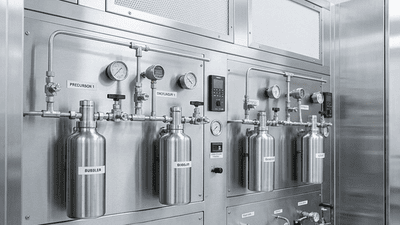
Precursor performance depends on how the chemical reaches the chamber. Some materials require carefully controlled heating to generate vapor. Others demand particular handling arrangements because of their reactivity or stability.
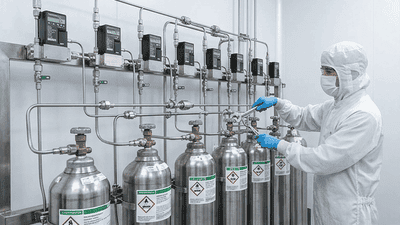
Containers, valves, seals, transfer lines, and delivery settings can influence consistency. Temperature variation or contamination can alter the effective dose, while unsuitable handling can create safety and reliability problems.
Packaging therefore belongs inside the technical offering. A supplier selling a chemical without dependable delivery support leaves an important part of the manufacturing challenge unresolved.
This also explains why synthesis capacity is not the same as commercially usable capacity. Purification, filling, container availability, analytical release, transport, and customer acceptance can each become constraints. The relevant output is qualified material delivered in a usable configuration, not simply kilograms produced.
Precursor demand depends on several interacting variables: wafer starts, process mix, the number of relevant deposition steps, dose requirements, utilization efficiency, and selling prices.
A transition toward more complex structures can increase consumption per wafer. Yet customers may offset part of that increase through better delivery control or process optimization. Competing suppliers can also pressure prices even as physical volumes expand.
High-bandwidth memory adds another analytical complication. It supports demand for sophisticated DRAM, but stacking more dies does not automatically multiply every front-end precursor requirement by the same factor. Wafer production, die size, yield, and the underlying DRAM process all matter.
For investors, the connection between AI demand and precursor revenue must therefore be traced through customer production decisions. A broad semiconductor growth narrative is insufficient evidence for a specific supplier’s earnings outlook.
Useful indicators go beyond announced capacity and headline market forecasts:
Customer concentration deserves particular attention. A close relationship can accelerate development, but it can also make revenue sensitive to one manufacturer’s capital spending, inventory cycle, or process redesign.
Product concentration creates a similar trade-off. A supplier may enjoy an excellent position in a narrowly defined chemistry while remaining vulnerable to substitution. Diversification is valuable only when the additional products are commercially qualified, not merely listed in a development presentation.
Korean suppliers hold an influential position because they developed alongside customers whose memory processes impose demanding deposition requirements. Their advantage rests on accumulated knowledge: how to make a molecule reliably, deliver it consistently, and support it inside a working manufacturing process.
That position remains contested by international competitors, changing ownership structures, new production locations, and evolving device architectures. No national label removes the need to examine individual products and qualification status.
As ALD and CVD become more important to three-dimensional manufacturing, the most valuable suppliers will be those that keep pace with changing structures and interfaces. The enduring competitive asset is not precursor volume alone. It is the ability to turn specialized chemistry into dependable film performance, generation after generation.